Bacteria: Life History and Ecology

Bacteria grow in a wide variety of habitats and conditions.
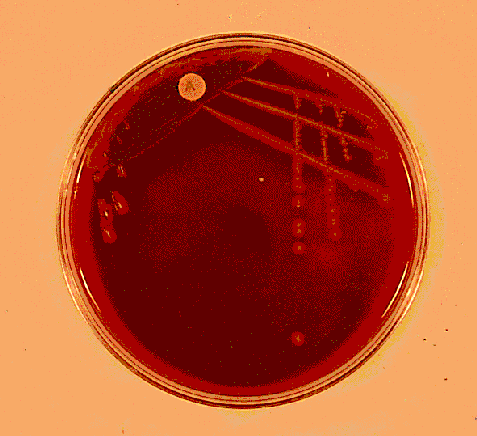
When most people think of bacteria, they think of disease-causing organisms, like the Streptococcus bacteria growing in culture in this picture, which were isolated from a man with strep throat. While pathogenic bacteria are notorious for such diseases as cholera, tuberculosis, and gonorrhea, such disease-causing species are a comparatively tiny fraction of the bacteria as a whole.
Bacteria are so widespread that it is possible only to make the most general statements about their life history and ecology. They may be found on the tops of mountains, the bottom of the deepest oceans, in the guts of animals, and even in the frozen rocks and ice of Antarctica. One feature that has enabled them to spread so far, and last so long is their ability to go dormant for an extended period.
Bacteria have a wide range of envronmental and nutritive requirements.
Most bacteria may be placed into one of three groups based on their response to gaseous oxygen. Aerobic bacteria thrive in the presence of oxygen and require it for their continued growth and existence. Other bacteria are anaerobic, and cannot tolerate gaseous oxygen, such as those bacteria which live in deep underwater sediments, or those which cause bacterial food poisoning. The third group are the facultative anaerobes, which prefer growing in the presence of oxygen, but can continue to grow without it.
Bacteria may also be classified both by the mode by which they obtain their energy. Classified by the source of their energy, bacteria fall into two categories: heterotrophs and autotrophs. Heterotrophs derive energy from breaking down complex organic compounds that they must take in from the environment -- this includes saprobic bacteria found in decaying material, as well as those that rely on fermentation or respiration.
The other group, the autotrophs, fix carbon dioxide to make their own food source; this may be fueled by light energy (photoautotrophic), or by oxidation of nitrogen, sulfur, or other elements (chemoautotrophic). While chemoautotrophs are uncommon, photoautotrophs are common and quite diverse. They include the cyanobacteria, green sulfur bacteria, purple sulfur bacteria, and purple nonsulfur bacteria. The sulfur bacteria are particularly interesting, since they use hydrogen sulfide as hydrogen donor, instead of water like most other photosynthetic organisms, including cyanobacteria.

Bacteria play important roles in the global ecosystem.
The ecosystem, both on land and in the water, depends heavily upon the activity of bacteria. The cycling of nutrients such as carbon, nitrogen, and sulfur is completed by their ceaseless labor.
Organic carbon, in the form of dead and rotting organisms, would quickly deplete the carbon dioxide in the atmosphere if not for the activity of decomposers. This may not sound too bad to you, but realize that without carbon dioxide, there would be no photosynthesis in plants, and no food. When organisms die, the carbon contained in their tissues becomes unavailble for most other living things.Decomposition is the breakdown of these organisms, and the release of nutrients back into the environment, and is one of the most important roles of the bacteria.
The cycling of nitrogen is another important activity of bacteria. Plants rely on nitrogen from the soil for their health and growth, and cannot acquire it from the gaseous nitrogen in the atmosphere. The primary way in which nitrogen becomes available to them is through nitrogen fixation by bacteria such as Rhizobium, and by cyanobacteria such as Anabaena, Nostoc, and Spirulina, shown at right. These bacteria convert gaseous nitrogen into nitrates or nitrites as part of their metabolism, and the resulting products are released into the environment. Some plants, such as liverworts, cycads, and legumes have taken special advantage of this process by modifying their structure to house the basteria in their own tissues. Other denitrifying bacteria metabolize in the reverse direction, turning nitrates into nitrogen gas or nitrous oxide. When colonies of these bacteria occur on croplands, they may deplete the soil nutrients, and make it difficult for crops to grow.
 If you yelled for 8 years, 7 months, and 6 days, you would have
produced enough sound energy to heat up one cup of coffee. (Hardly
seems worth it.)
A pig's orgasm lasts for 30 minutes.
(In my next life I want to be pig.)
Banging your head against a wall uses 150 calories an hour.
(Still not over that pig thing.)
Humans and dolphins are the only species that have sex for pleasure.
(Is that why Flipper is always smiling? And why isn't the pig
included in this list? Maybe 30 minute orgasms aren't as fun as I
imagine...)
On average, people fear spiders more then they do death.
The strongest muscle in the body is the tongue. (Hmmmmmm......)
A crocodile cannot stick out its tongue.
The ant can lift 50 times its own weight, can pull 30 times its own
weight, and always falls over on its right side when intoxicated.
(From drinking little bottles of....? Did the gov't pay for this
research?)
Polar bears are left handed.
(Who knew? Who cares? Did the gov't pay for this too? Probably...)
The flea can jump 350 times its body length. That's like a human
jumping the length of a football field.
A cockroach will live 9 days without its head before it starves to
death.
The male praying mantis cannot copulate while it's head is attached
to its body. The female initiates sex by ripping the male's head
off. (Hi, honey. I'm home. What the...?)
Some lions mate over 50 times a day.
(In my next life I still want to be a pig.
Quality over quantity, you know?)
Butterflies taste with their feet. (Oh, jeez!)
Elephants are the only animals that can't jump.
An ostrich's eye is bigger than its brain.
(I know some people like that.)
Starfish don't have brains.
(I know some people like this too.)
It takes your food seven seconds to get from your mouth to your stomach.
One human hair can support 6.6 pounds.
The average man's penis is two times the length of his thumb.
Human thighbones are stronger than concrete.
A woman's heart beats faster than a man's.
There are about one trillion bacteria on each of your feet.
Women blink twice as often as men.
The average person's skin weighs twice as much as the brain.
Your body uses 300 muscles to balance itself when you are standing still.
If saliva cannot dissolve something, you cannot taste it.
Women Will be finished reading this by now.
And Men Are still busy checking their thumbs.
If you yelled for 8 years, 7 months, and 6 days, you would have
produced enough sound energy to heat up one cup of coffee. (Hardly
seems worth it.)
A pig's orgasm lasts for 30 minutes.
(In my next life I want to be pig.)
Banging your head against a wall uses 150 calories an hour.
(Still not over that pig thing.)
Humans and dolphins are the only species that have sex for pleasure.
(Is that why Flipper is always smiling? And why isn't the pig
included in this list? Maybe 30 minute orgasms aren't as fun as I
imagine...)
On average, people fear spiders more then they do death.
The strongest muscle in the body is the tongue. (Hmmmmmm......)
A crocodile cannot stick out its tongue.
The ant can lift 50 times its own weight, can pull 30 times its own
weight, and always falls over on its right side when intoxicated.
(From drinking little bottles of....? Did the gov't pay for this
research?)
Polar bears are left handed.
(Who knew? Who cares? Did the gov't pay for this too? Probably...)
The flea can jump 350 times its body length. That's like a human
jumping the length of a football field.
A cockroach will live 9 days without its head before it starves to
death.
The male praying mantis cannot copulate while it's head is attached
to its body. The female initiates sex by ripping the male's head
off. (Hi, honey. I'm home. What the...?)
Some lions mate over 50 times a day.
(In my next life I still want to be a pig.
Quality over quantity, you know?)
Butterflies taste with their feet. (Oh, jeez!)
Elephants are the only animals that can't jump.
An ostrich's eye is bigger than its brain.
(I know some people like that.)
Starfish don't have brains.
(I know some people like this too.)
It takes your food seven seconds to get from your mouth to your stomach.
One human hair can support 6.6 pounds.
The average man's penis is two times the length of his thumb.
Human thighbones are stronger than concrete.
A woman's heart beats faster than a man's.
There are about one trillion bacteria on each of your feet.
Women blink twice as often as men.
The average person's skin weighs twice as much as the brain.
Your body uses 300 muscles to balance itself when you are standing still.
If saliva cannot dissolve something, you cannot taste it.
Women Will be finished reading this by now.
And Men Are still busy checking their thumbs.





 That chameleons change colors to disguise themselves is a common misconception. Scientists believe that the real reason for color changing is to communicate with other chameleons and express their mood, like a reptilian mood ring! If the color happens to match the background, it's completely coincidental.